Tuesday, December 6, 2016

Worry Dolls for OSU


With many close connections to the OSU community, the attack at Ohio State left my elementary students fearful, anxious, and wanting to be part of the solution. As a way to process tragedy through artmaking and spread love in our community at a time filled with fear, hate, and anxiety, 4th grade students at Chapman Elementary  have decided to create worry dolls for students and faculty at Ohio State. 

Ohio State's AAEP department has put a flyer in their student newsletter and OSU students and staff have been sending their information!


What are worry dolls?

Worry dolls, originating in Guatemala, are small handmade dolls composed of various types of wires, strings, and fabrics.
Tell your dolls your worries at night, then hide them under your pillow. The next morning the dolls will have taken part of your worries away.

How can you receive a worry doll?

If you are interested in helping our students spread their love by receiving a worry doll, you can send your name and address to callicotte_patrick@dublinschools.net. Worry dolls will be
mailed out starting on Wednesday, December 7th.

Tuesday, November 22, 2016

Differentiating Thinking Routines

This year at Chapman, we do not have monthly staff meetings. Instead, our administration has put us in groups of about 10 teachers that cover almost every teaching area here at Chapman. These groups have been given the freedom to examine our own pedagogy and collaboratively develop topics of study that will benefit all of the teachers in our groups.

 The group of teachers that I am facilitating has identified the following through-line questions that will guide our professional development this year:


One concern around thinking routines and the culture of enrichment that we have heard a lot is the feeling that thinking routines often rely on communication (or other) skills that not all of our students possess. For our November meeting, our group focused on ways of differentiating thinking routines to increase the inclusion of all learners.

Each educator in the group focused on one student who they often find themselves differentiating for (a student who is gifted, a student with a disability, a student learning English for their first time, etc.). As we watched video examples of thinking routines, each educator identified difficulties that the thinking routine might present their students.

The entire group then worked collaboratively to brainstorm ways to differentiate the thinking routine so that all of the concerns brought up for each individual student were addressed. I am taking the different possibilities for differentiation and formatting them into documents that can be available to other educators. Check out our document for how to differentiate See-Think-Wonder below!


These documents, as well as other resources for creating a culture of thinking, will be available on my Weebly, www.acescultureofthinking.weebly.com. 

Friday, November 11, 2016

The Failure Bow!

“Failure should be our teacher, not our undertaker. Failure is delay, not defeat. It is a temporary detour, not a dead end. Failure is something we can avoid only by saying nothing, doing nothing, and being nothing.” - Denis Waitley

This past week I decided to gather 5th grade students' current thoughts on failure. I asked each student to pick a color, a symbol, and an image that they feels represents failure. 

Check out the results from students in Mrs. Kalix's 5th grade class:


How do we change students’ negative associations with the word “failure” and help them learn to embrace, learn from, and persevere through failures?
 One of many ways that we will be using in art this year is...

 THE FAILURE BOW!

Students spent 15 minutes coming up with an imaginary failure, such as making a PB&J using hair gel instead of jelly, and drawing an artwork of their failure.
 Students then took turns presenting their epic failure to the class. The class then responded to each presented failure with a celebratory cheer. The presenter then did an elaborate bow in response to the cheering audience.


The failure bow helps students create a new relationship with what we think of as failure. When we fail, it often means we were pushing ourselves to take risks and develop new skills. Our so-called failures can lead us to possibilities we never would have imagined.

That is worth celebrating!

What's next?

5th grade's next project will focus on failures and building new relationships with what we think of as a failure.

Stay tuned to see the students' colors, symbols, and images that they choose to represent failure after their project is finished!

Tuesday, November 8, 2016

Thinking Routine Helps Students Process Hurricane Matthew


Earlier this month, the devastation of Hurricane Matthew was on every news channel and I noticed that in nearly every art class, the hurricane was the topic of many of the curious questions, conversations, and expressions of concern. This made me decide to sit down and do a thinking routine (Claim-Support With Evidence) with the students as a way to discuss the impact of Hurricane Matthew and use artmaking to process the devastation that many are facing.

The lesson started with a discussion about a photograph of a boy standing among Hurricane Matthew's aftermath in Haiti. I showed the students the picture one section at a time, each time having them take 2 minutes to silently look and investigate the picture, then respond with a claim of what they think is going on in the picture and support that claim with evidence that they see.

After the exploration of the picture, students asked many questions about Hurricane Matthew and the country of Haiti, so we explored the facts. One student asked why our news channels only talked about the impact of Hurricane Matthew on Florida, South Carolina, and North Carolina rather than Haiti, so students discussed possible answers to this question for quite some time.

After the discussion, students were told that we would spend the rest of the art class creating something, real or imaginary, that would help the people of Haiti.

Check out the conversation and a few of the students' artworks below!

Monday, October 31, 2016

Halloween and Ableism: Protraying (dis)Ability Through Costumes

While Halloween remains my favorite holiday of the year because of its ability to inspire young minds to create costumes and get out of their comfort zones, it is also a holiday that is full of insensitive portrayals of marginalized groups of people, even among educators, that I think we need to be careful of.

“Many people think that people with disabilities have a monopoly on pain. People with disabilities do not have a monopoly on pain, we just have a pain that nobody cares about.”
-Justin Martin, a writer, poet, and advocate from Hilliard, Ohio
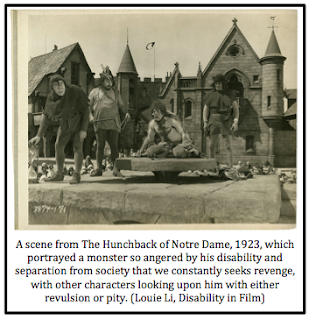
The portrayal of people with disabilities for entertainment has a long history of exploitation in American media, such as films around the turn of the 20th century that employed depictions of people with disabilities in comedy and horror films. This year, just as in many years past, I continue to see members of our community use disability as comedic relief in their Halloween costumes, such as pretending to have a walking abnormality when portraying a monster or using a walker when portraying an elderly person. The issue here is that portraying people belonging to an oppressed group as entertainment is belittling and dehumanizing. As advocate Lydia X. Z. Brown states on their website, Austistic Hoya, “This process of enfreakment has a long history that includes the freak show sideshows accompanying circuses that put people with visible disabilities and deformities on display for public amusement and pity. When it comes to these types of portrayals, it contributes to the message that says that these are not people worthy of respect or dignity for no reason other than their disabilities.” (Austistichoya.com)

As educators, we must be advocates for ALL of our students. Are you portraying a disability in a form that subliminally messages to students that it disability is a pitiful struggle? Would you feel comfortable pretending to be someone with Down Syndrome for Halloween? If not, then why do we feel comfortable portraying someone who requires a walker, cane, or wheelchair? Would you feel comfortable pretending to use a walker in front of a student whose requires the daily use of a walker? While you may laugh and then walk away from that walker at the end of the day, that student’s walker is intertwined with their being and they cannot remove themselves from needing it whenever they please. Just as we have done with blackface and many other culturally insensitive forms of entertainment, I believe it is time for us to reflect on how we portray marginalized groups as entertainment, especially when we, as educators, are the role models for the future generation.

“So, call it simulation, call it pretending, call it faking, or call it playing disability. Whatever it is, and no matter if it’s done with ill will, kindness, or anything in between, it’s not cool to play around in a wheelchair, the space that is so much a part of my identity and my reality.”

-Emily Ladau, Words I Wheel By